Showing posts with label armed guard. Show all posts

Wednesday, 8 August 2012

Torngat Mountains National Park, base camp

19 July 2012, continued.
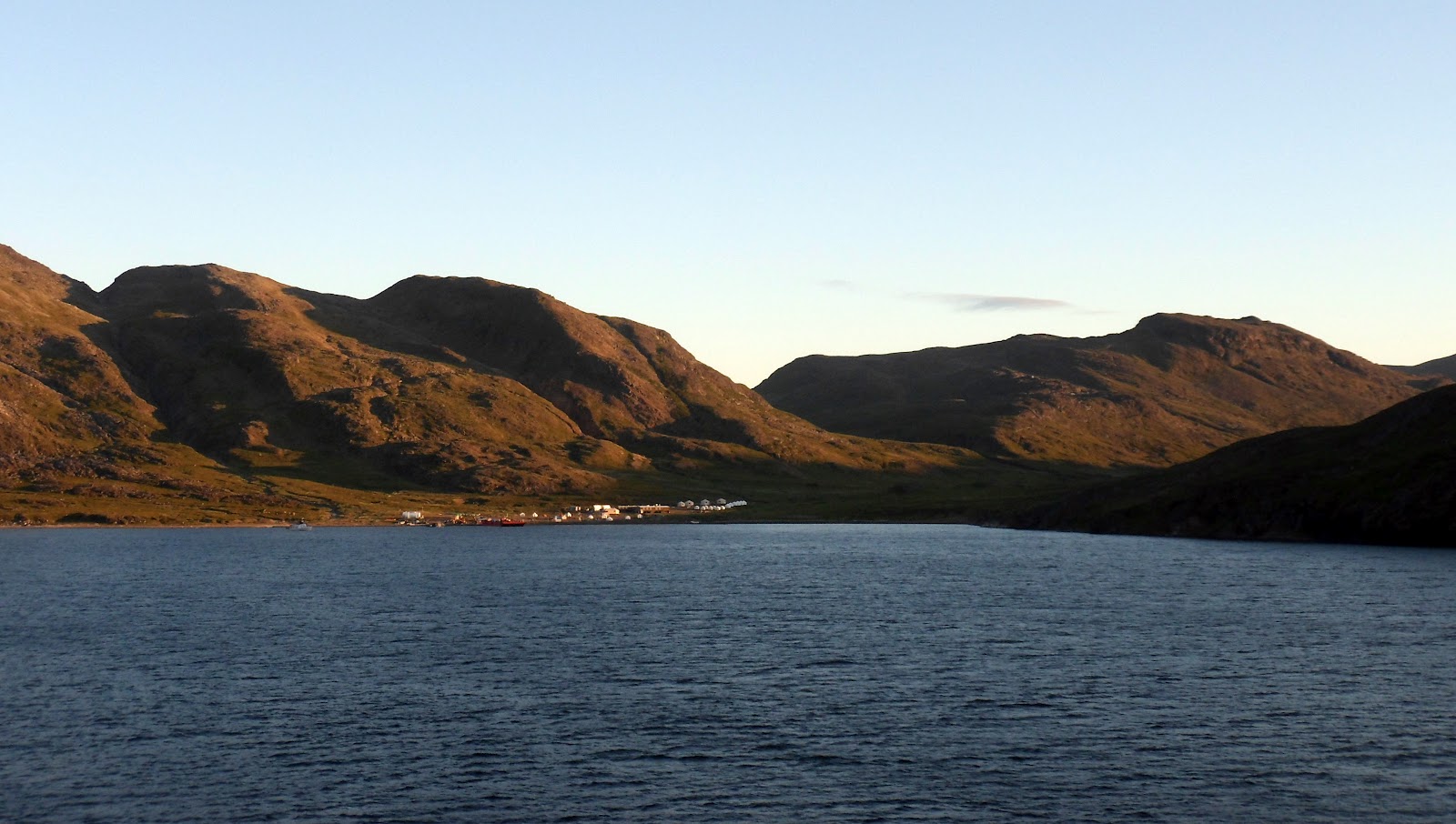
Base camp at St. John's Harbour, Saglek Fiord, about 4 pm.
Sea lungwort, Mertensia maritima.
One flowered wintergreen, Moneses uniflora.
Parks Canada polar bear guard - No firearms
allowed in the park except for employees.
The base camp has an 8 strand electric fence
 around it against bears, electrified at night.
During the day they have guards.
Arnica angustifolia.

Jane, Parks Canada guide/guard, and Jimmy.
Zohra getting close to the waterfall.
Interesting rocks, blue sky.
An old rock blind built to hunt caribou.
RV Akademik Ioffe anchored in St John's Harbour.
Labrador milk vetch, Astragalus labradoricus(?), and Snow buttercup, 
Ranunculus nivalis(?). It's really difficult to identify plants with certainty, 
the only arctic plant books are for Svalbard, Greenland or Alaska.
Accommodation for visitors at base camp.
The oatmeal raisin cookies were dynamite. 
"Labrador Inuit Development Corporation (LIDC) operates the Torngat Mountains Base Camp and Research Station from mid-July to early September. The camp is at St. John’s Harbour which is in Saglek Bay, adjacent to the southern boundary of the park, and supports a Parks Canada visitor reception and orientation service, visitor activities and scientific research. The basecamp offers tent accommodations and the provision of speedboats, longliners, polar bear guards, helicopter and fixed wing charters.  http://www.torngatbasecamp.ca

"The camp accommodates up to 80 people and is outfitted with a dining facility, commercial kitchen, tent accommodation in various forms, green technology with the largest solar panel array in Labrador, a planned green waste disposal and grey water filtering system, flush toilets, showers, electrically alarmed fencing for protection from polar and black bears, and armed bear guards on 24-hour watch.
Bear guards are Inuit from the Nuniatsiavut and Nunavik territories. The bear guards have all grown up living on the land hunting and fishing. Their knowledge and connection to the land is deep and their understanding of bear behaviour is extensive. The safest way to travel in the park is with Inuit. They are hosts in their homeland where their ancestors have lived for thousands of years. Their role is not that of a trip leader or trip guide in the classic sense, but they will guide you over their traditional homeland, regaling you with stories of their ancestors. Your safety is paramount.

"Packages are available including this top-of-the-line one: Polar Bears and Northern Lights, $25,000 (plus GST). Arctic Kingdom is offering a very intimate four person 8 day trip that is set in the foothills of one of Canada's remotest mountain ranges – the Torngat Mountains. Combining stunning scenery, the exquisite and awe inspiring northern lights, top-of-the-line remote accommodations in our new Arctic Igloo Dome base camp, delicious meals, and best of all – and the main reason for coming – up close and personal polar bear photograph opportunities under the professional guidance of local Inuit guides, this is a truly exceptional trip. Available dates include March 19-25 and March 25-31, 2013."

The Parks Canada website is also informative, particularly about the Inuit and their predecessors, geology and (oh good) Arctic flora. I will have to correct the descriptions of some of my plant/flower photos. 
A team of geologists from the University of Tokyo have just found rocks 4 billion years old here, the latest candidate for the oldest rocks on earth.

Solar panels to charge batteries for electric fence etc.
We returned to the ship around 7 pm for dinner, and left base camp
about 9 pm to anchor in the North Arm of Saglek Fiord
overnight. It gets dark around 9:40 pm here at this time of year.

Hebron, Labrador

19 July 2012.

Hebron was the most northerly Moravian mission, founded in 1831 and closed down in 1959 because of overcrowding and TB. Half of the 59 families moved on their own and the other half were relocated further south in Nain and Hopedale. Many starved because the best hunting, fishing and trapping spots were already claimed. The site is a National Historic Site. In 2005, Newfoundland and Labrador Premier Danny Williams apologized to people affected by the relocations. In August 2009, the provincial government unveiled a monument next to the church at Hebron, with an inscribed apology for the site closure.
My first polar bear! (Click to enlarge.) We first saw it
swimming along the shore, then climbing the hill.
We went ashore around 8:40 am and left at 11 am.
The Moravian church and mission. The outside has been
renovated by Parks Canada within the last 10 years. 
Perhaps this is why the polar bear was around - arctic char drying.
A family of 4 from Nain are here for the summer with two dogs.
 The family chased off the polar bear before we landed.
Split arctic char drying.
The family from Nain made us feel welcome.
"The summer season marks the beginning of the Hebron Ambassador Program. The Merkuratsuk family, Joseph and Jenny Merkuratsuk of Nain, along with their sons Simeonie and Julius, travelled via long liner from Nain to Hebron on July 12."

Last decaying houses
Ropes attached to heavy rocks hold down the shed
against strong winds. The boys sleep in the tent.

Cold sky.
Cupola on the church.
A gumboot hike - wet underfoot. 
Polar bear guard on duty.
As well as a Moravian cemetery there are a few traditional
Inuit graves, a bit like stone igloos. These have openings to
allow access for small animals.
My photo of the two boys and their mother.
Kerry and Patricia made a fuss of the two dogs,
although we were told they are not pets.
Patricia (from Pangnirtung, NU) and dog.
Hebron dog.
Iceberg in the mist as we sail up to Torngat.

Sunday, 5 August 2012

Okak and Mugford Tickle

18 July 2012
The tide was wrong for a landing at Okak island so we
landed instead on the mainland just to the north 
When looking for an anchorage
both captain and first mate are on duty on the bridge
The captain keeps an eye on the depth
A wet landing, gumboots required. Water temperature
6 degrees C. Air temperature 4 degrees C at 7 am.
Bear scat, caribou antler
Stone tent circle (tent ring).
Ramah chert, sought after for making tools.
More caribou antlers
The first shore party checked out the bear situation before
we landed. Each group had an armed guard in case of polar
bears. A third guard was up high.
A vole or lemming skull
Our ship in the distance
Me again. This area had a great variety of flora:
crowberries, blueberries, willow,  Labrador tea,
butterwort,  and wintergreen. See the next post...
Mugford Tickle is a narrow but deep channel between two
islands with 1000 foot high cliffs on each side of half mile wide
channel. There was a strong, cold wind, choppy sea, and low
cloud or mist, so we did this on the ship.
Mountains and mist
A grounded iceberg in Mugford Tickle.


Saturday, 4 August 2012

Hopedale

17 July 2012.
11° C, light cloud, small icebergs
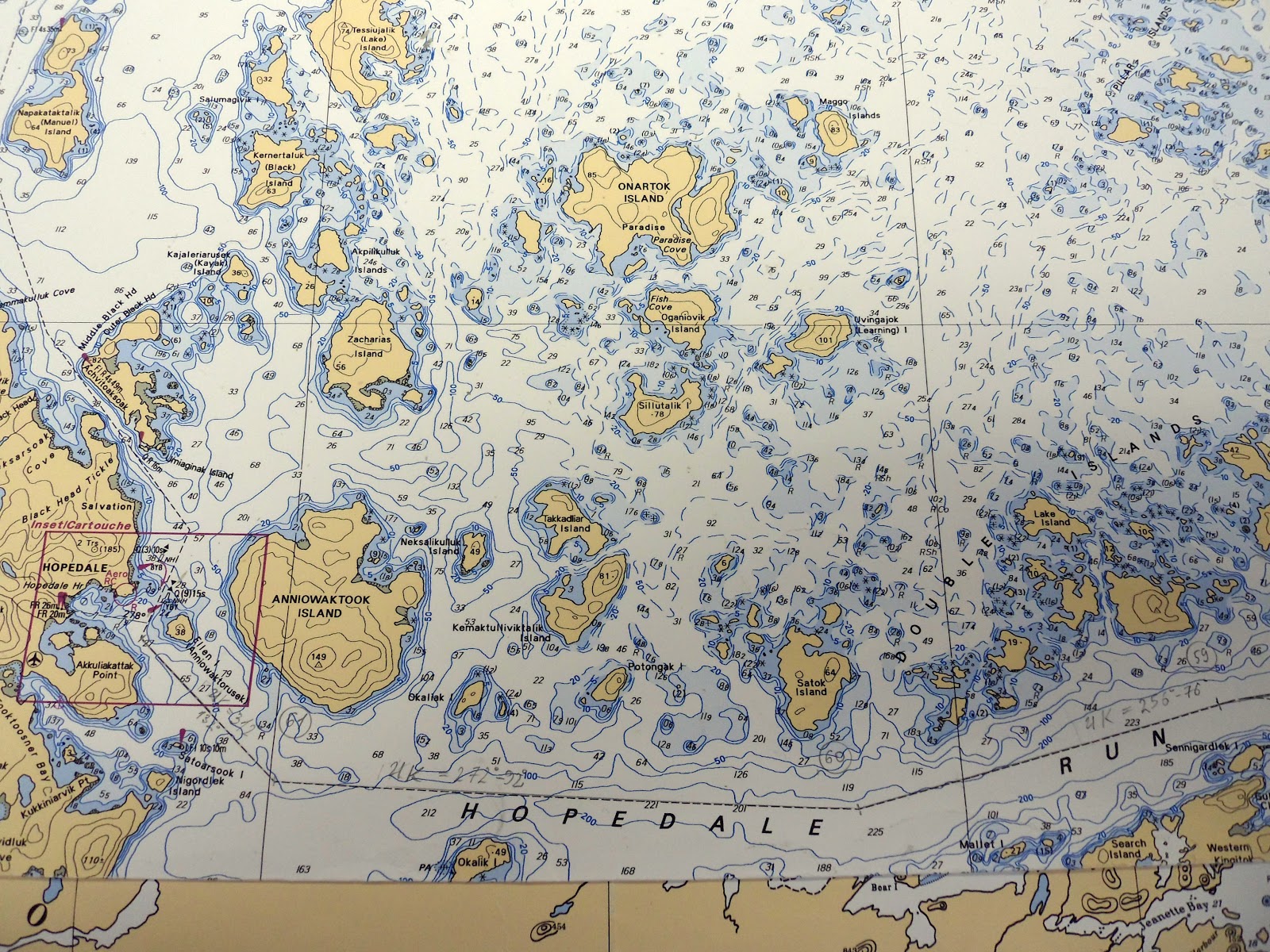
Hopedale is on the mainland, on the left. Click to enlarge.
Hopedale residents
Friendly dog and woodpile
We hiked to the top of hill for a view of Hopedale
and our ship in the bay, from former DEW line base
Boris is one of our armed polar bear guards as well as the
boss of the Zodiac drivers. Sean Cadigan is on his left.
The Moravian mission in Hopedale, next to the church
(see also entry on Moravians in "Labrador and Nunatsiavut"
for  photos of church)
Moravian church and mission buildings with field of cotton grass
The museum was very interesting here. Tools, 18th century musical instruments, medical equipment, and so on. It was a choppy wet ride back to the ship on the Zodiac. The ship had to be moved (with bow thrusters) to create a lee for transfers from the Zodiac, as the end of the gangway was under the waves.
Sunset and icebergs
The first mate, Alexander, steered nearer the iceberg on request!