19 July 2012, continued.
 |
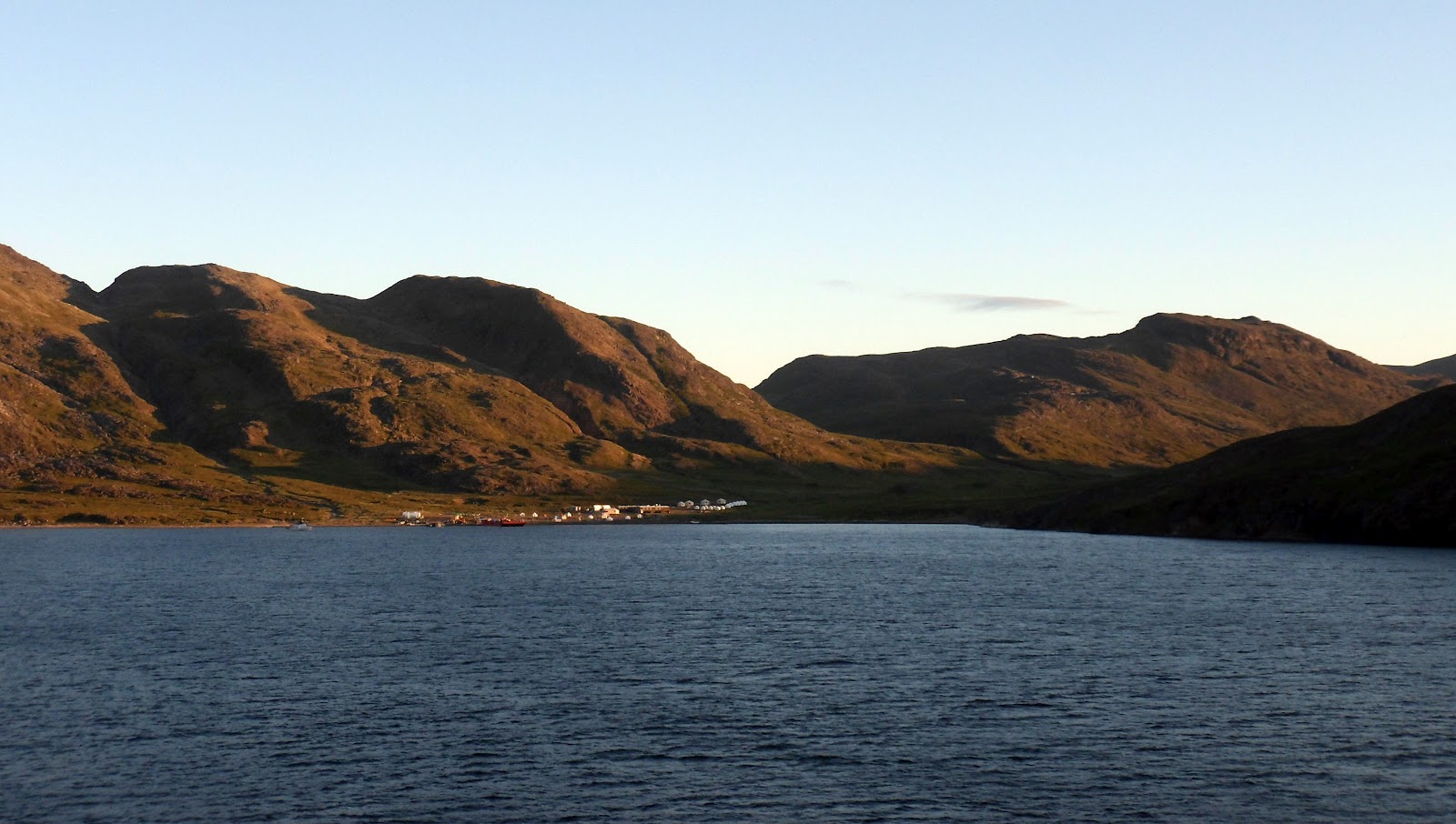
| Base camp at St. John's Harbour, Saglek Fiord, about 4 pm. |
 |
| Sea lungwort, Mertensia maritima. |
 |
| One flowered wintergreen, Moneses uniflora. |
 |
Parks Canada polar bear guard - No firearms
allowed in the park except for employees. |
 |
The base camp has an 8 strand electric fence
around it against bears, electrified at night.
During the day they have guards. |
 |
| Arnica angustifolia. |
 |
| Jane, Parks Canada guide/guard, and Jimmy. |
 |
| Zohra getting close to the waterfall. |
 |
| Interesting rocks, blue sky. |
 |
| An old rock blind built to hunt caribou. |
 |
| RV Akademik Ioffe anchored in St John's Harbour. |
 |
Labrador milk vetch, Astragalus labradoricus(?), and Snow buttercup,
Ranunculus nivalis(?). It's really difficult to identify plants with certainty,
the only arctic plant books are for Svalbard, Greenland or Alaska.
|
 |
Accommodation for visitors at base camp.
The oatmeal raisin cookies were dynamite. |
"Labrador Inuit Development Corporation (LIDC) operates the Torngat Mountains Base Camp and Research Station from mid-July to early September. The camp is at St. John’s Harbour which is in Saglek Bay, adjacent to the southern boundary of the park, and supports a Parks Canada visitor reception and orientation service, visitor activities and scientific research. The basecamp offers tent accommodations and the provision of speedboats, longliners, polar bear guards, helicopter and fixed wing charters. http://www.torngatbasecamp.ca
"The camp accommodates up to 80 people and is outfitted with a dining facility, commercial kitchen, tent accommodation in various forms, green technology with the largest solar panel array in Labrador, a planned green waste disposal and grey water filtering system, flush toilets, showers, electrically alarmed fencing for protection from polar and black bears, and armed bear guards on 24-hour watch.
Bear guards are Inuit from the Nuniatsiavut and Nunavik territories. The bear guards have all grown up living on the land hunting and fishing. Their knowledge and connection to the land is deep and their understanding of bear behaviour is extensive. The safest way to travel in the park is with Inuit. They are hosts in their homeland where their ancestors have lived for thousands of years. Their role is not that of a trip leader or trip guide in the classic sense, but they will guide you over their traditional homeland, regaling you with stories of their ancestors. Your safety is paramount.
"Packages are available including this top-of-the-line one: Polar Bears and Northern Lights, $25,000 (plus GST). Arctic Kingdom is offering a very intimate four person 8 day trip that is set in the foothills of one of Canada's remotest mountain ranges – the Torngat Mountains. Combining stunning scenery, the exquisite and awe inspiring northern lights, top-of-the-line remote accommodations in our new Arctic Igloo Dome base camp, delicious meals, and best of all – and the main reason for coming – up close and personal polar bear photograph opportunities under the professional guidance of local Inuit guides, this is a truly exceptional trip. Available dates include March 19-25 and March 25-31, 2013."
The Parks Canada website is also informative, particularly about the Inuit and their predecessors, geology and (oh good) Arctic flora. I will have to correct the descriptions of some of my plant/flower photos.
A team of geologists from the University of Tokyo have just found rocks 4 billion years old here, the latest candidate for the oldest rocks on earth.
 |
| Solar panels to charge batteries for electric fence etc. |
 |
We returned to the ship around 7 pm for dinner, and left base camp
about 9 pm to anchor in the North Arm of Saglek Fiord
overnight. It gets dark around 9:40 pm here at this time of year. |