Showing posts with label polar bear. Show all posts

Saturday, 11 August 2012

On being flexible

21 July 2012.
In the Arctic and anywhere at sea, one expects to alter plans to fit in with tides and the weather. However it was a surprise to learn last night after dinner, that Frobisher Bay is blocked with pack ice two weeks later than usual, despite the hot, dry weather, and that the Canadian Coast Guard Ice Operations Office has advised that it would be unsafe to attempt to reach Iqaluit even with an icebreaker escort, due to the high pressure ice jam. An ice-strengthened vessel of similar ice class had already attempted transit and suffered damage. The ice jam is apparently due to the lack of a "dynamic weather event," or what might normally be called bad weather, with winds blowing the ice out of Frobisher Bay. The Master of the RV Akademik Ioffe, Captain Sazonov, has chosen to divert to Happy Valley - Goose Bay, a port that has an airport big enough to cope with an unexpected influx of about 80 people, passengers and staff, trying to fly home. We were told about this last night after our wonderful day in Saglek Bay area, but obviously the expedition leaders had been working on this for sometime. We will make shore excursions to Dog Island, Nain and Rigolet on the way.

Frobisher Bay is the red area marked C on the bottom left, with Iqaluit at it's head.
Red indicates that the concentration of ice is 90-100%

Dog Island

I woke early and the ship is forging ahead at top speed, just over 14 knots. There is quite a swell. 
We arrived off Dog Island, close to Nain, around 10 am. Traditionally dog teams would be left here for the summer, and fed every 2 or 3 days. These dogs can be fierce, they are not pets, and they wouldn't want them running around where there are children. As usual the first ashore were the bear guards, also on the look-out for dogs - but we saw neither bears nor dogs.

Click to enlarge. Dog island is on the right, Nain is close
to the centre of the chart on the mainland.
 There is a sandy shore here, unlike the other islands we've seen. Apparently a good place to look for signs of earlier inhabitants is where there's a blow-out, where the vegetation and sand has been lifted by the wind, exposing such things as interesting rocks, or knife points and chert tools if one's lucky.
Not yet identified.
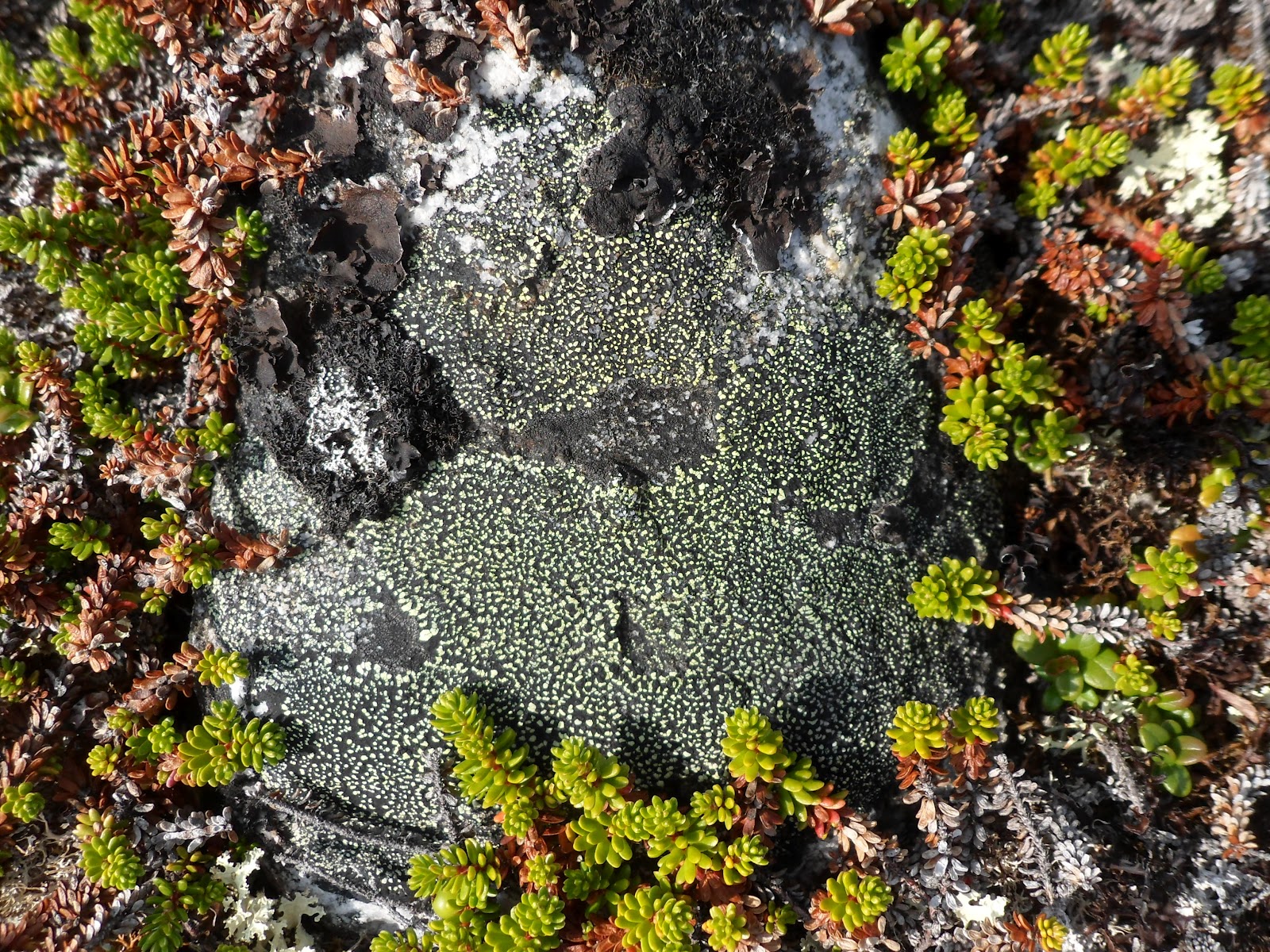
Lichen and crowberry plants.
Cotton grass and the summit of Dog Island.
I'm confused about all these different berries...
Partridgeberry (Lingonberry), Mitchella repens.
I think the flowers are butterwort, but can't see the leaves.
Jimmy botanising rather than looking out for bears.

Moss campion, Silene acaulis, forms mounds.
Trees, an unusual sight. This is about the northerly limit for trees.
Returning to the ship.

 Nain

I mentioned Nain some time ago (2 August post on Labrador and Nunatsiavut, where there are photos of the outside and interior of the church). As well as the first Moravian Mission site, it is now the administrative centre for Nunatsiavut, the Inuit administered lands of Newfoundland and Labrador.

Inside the church there's a historical display. Mugs (of tea)
and candles are significant in the Moravian religion.
Now 236 years old.
 We were given a tour of the fish plant, where they smoke arctic char and ship it to a distributor in Goose Bay. They didn't seem to know where it went after that. No photos are allowed in the fish plant. It was quite busy even at 4 pm on a Saturday.
Then we went to visit some stone carvers' workshops to make up for missing Iqaluit. Beautiful whale shapes made from soapstone and serpentine at the Terriak's workshop (John and son David). Next we made our way through the small town to the craft store at the Parks Canada HQ for Torngat Mountains National Park. Here there were even more beautiful stone carvings: birds, whales, seals. Seal skins for $100 to $240, and the usual T shirts, ear-rings and so on. The floor of the meeting room here was shiny, iridescent labradorite stone.
The new K to grade 3 school, and teachers' apartments.
Jens Haven Memorial School, Nain.
The grade 4 to grade 12 school.
Jens Haven Memorial School, Nain.
There was a very nice craft store here.
Flagpoles outside the Nunatsiavut administration centre.
Nunatsiavut, Canadian, and Newfoundland & Labrador flags.
Inside the administration centre, another labradorite floor and polar bear rug.
Children's artwork celebrating Nunatsiavut.
Both in the church when we first arrived, and in the administration centre, we were greeted by Sarah Leo, who described herself as part of the Heritage Committee. Dave Lough, the Deputy Minister for Culture in the Tourism department, (a friend of Jim Payne's) who had arranged at short notice for stores to be open, and people to be there to talk to us, introduced Sarah Leo to us as the recently elected President of Nunatsiavut. She explained the importance of completing a new Cultural Centre in time for a Circumpolar Arctic conference to be held in Nain in 2013.

They showed us a video, Till We Meet Again: Moravian Music in Labrador, described as follows:
"Sounds of Moravian choral music fill the churches of 18th century Nain, Labrador as the Inuit cultural landscape merges with Slavic tradition. The arrival of Moravian missionaries to the northern-most community in Labrador forever influenced the musical tradition of the people of Nunatsiavut." 

Unfortunately we had to leave before this had finished, but it is available on the CBC link. Apparently many of the music requests on the local radio station are for Moravian music.

Wednesday, 8 August 2012

Torngat Mountains National Park, base camp

19 July 2012, continued.
Base camp at St. John's Harbour, Saglek Fiord, about 4 pm.
Sea lungwort, Mertensia maritima.
One flowered wintergreen, Moneses uniflora.
Parks Canada polar bear guard - No firearms
allowed in the park except for employees.
The base camp has an 8 strand electric fence
 around it against bears, electrified at night.
During the day they have guards.
Arnica angustifolia.

Jane, Parks Canada guide/guard, and Jimmy.
Zohra getting close to the waterfall.
Interesting rocks, blue sky.
An old rock blind built to hunt caribou.
RV Akademik Ioffe anchored in St John's Harbour.
Labrador milk vetch, Astragalus labradoricus(?), and Snow buttercup, 
Ranunculus nivalis(?). It's really difficult to identify plants with certainty, 
the only arctic plant books are for Svalbard, Greenland or Alaska.
Accommodation for visitors at base camp.
The oatmeal raisin cookies were dynamite. 
"Labrador Inuit Development Corporation (LIDC) operates the Torngat Mountains Base Camp and Research Station from mid-July to early September. The camp is at St. John’s Harbour which is in Saglek Bay, adjacent to the southern boundary of the park, and supports a Parks Canada visitor reception and orientation service, visitor activities and scientific research. The basecamp offers tent accommodations and the provision of speedboats, longliners, polar bear guards, helicopter and fixed wing charters.  http://www.torngatbasecamp.ca

"The camp accommodates up to 80 people and is outfitted with a dining facility, commercial kitchen, tent accommodation in various forms, green technology with the largest solar panel array in Labrador, a planned green waste disposal and grey water filtering system, flush toilets, showers, electrically alarmed fencing for protection from polar and black bears, and armed bear guards on 24-hour watch.
Bear guards are Inuit from the Nuniatsiavut and Nunavik territories. The bear guards have all grown up living on the land hunting and fishing. Their knowledge and connection to the land is deep and their understanding of bear behaviour is extensive. The safest way to travel in the park is with Inuit. They are hosts in their homeland where their ancestors have lived for thousands of years. Their role is not that of a trip leader or trip guide in the classic sense, but they will guide you over their traditional homeland, regaling you with stories of their ancestors. Your safety is paramount.

"Packages are available including this top-of-the-line one: Polar Bears and Northern Lights, $25,000 (plus GST). Arctic Kingdom is offering a very intimate four person 8 day trip that is set in the foothills of one of Canada's remotest mountain ranges – the Torngat Mountains. Combining stunning scenery, the exquisite and awe inspiring northern lights, top-of-the-line remote accommodations in our new Arctic Igloo Dome base camp, delicious meals, and best of all – and the main reason for coming – up close and personal polar bear photograph opportunities under the professional guidance of local Inuit guides, this is a truly exceptional trip. Available dates include March 19-25 and March 25-31, 2013."

The Parks Canada website is also informative, particularly about the Inuit and their predecessors, geology and (oh good) Arctic flora. I will have to correct the descriptions of some of my plant/flower photos. 
A team of geologists from the University of Tokyo have just found rocks 4 billion years old here, the latest candidate for the oldest rocks on earth.

Solar panels to charge batteries for electric fence etc.
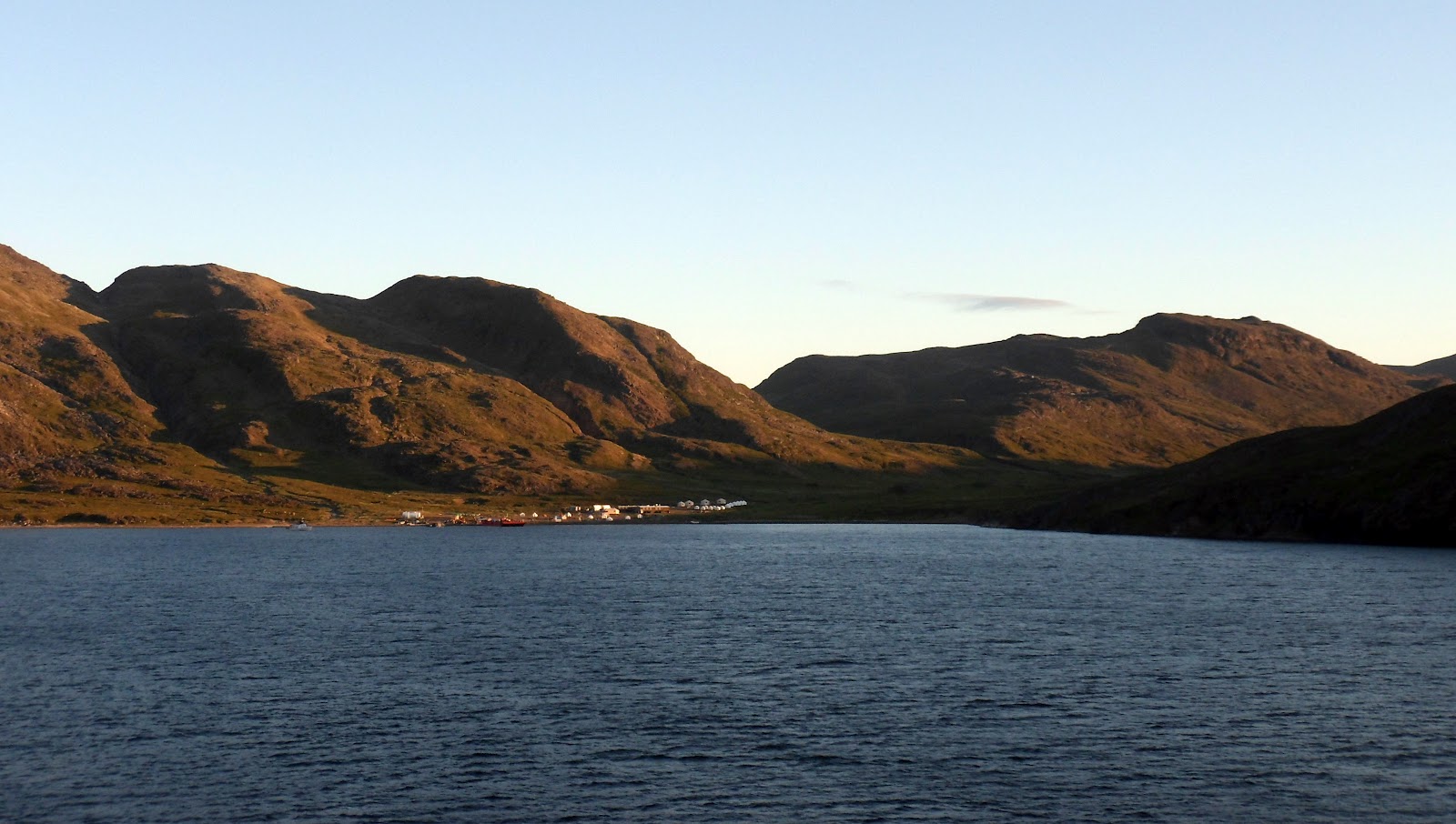
We returned to the ship around 7 pm for dinner, and left base camp
about 9 pm to anchor in the North Arm of Saglek Fiord
overnight. It gets dark around 9:40 pm here at this time of year.

Hebron, Labrador

19 July 2012.

Hebron was the most northerly Moravian mission, founded in 1831 and closed down in 1959 because of overcrowding and TB. Half of the 59 families moved on their own and the other half were relocated further south in Nain and Hopedale. Many starved because the best hunting, fishing and trapping spots were already claimed. The site is a National Historic Site. In 2005, Newfoundland and Labrador Premier Danny Williams apologized to people affected by the relocations. In August 2009, the provincial government unveiled a monument next to the church at Hebron, with an inscribed apology for the site closure.
My first polar bear! (Click to enlarge.) We first saw it
swimming along the shore, then climbing the hill.
We went ashore around 8:40 am and left at 11 am.
The Moravian church and mission. The outside has been
renovated by Parks Canada within the last 10 years. 
Perhaps this is why the polar bear was around - arctic char drying.
A family of 4 from Nain are here for the summer with two dogs.
 The family chased off the polar bear before we landed.
Split arctic char drying.
The family from Nain made us feel welcome.
"The summer season marks the beginning of the Hebron Ambassador Program. The Merkuratsuk family, Joseph and Jenny Merkuratsuk of Nain, along with their sons Simeonie and Julius, travelled via long liner from Nain to Hebron on July 12."

Last decaying houses
Ropes attached to heavy rocks hold down the shed
against strong winds. The boys sleep in the tent.

Cold sky.
Cupola on the church.
A gumboot hike - wet underfoot. 
Polar bear guard on duty.
As well as a Moravian cemetery there are a few traditional
Inuit graves, a bit like stone igloos. These have openings to
allow access for small animals.
My photo of the two boys and their mother.
Kerry and Patricia made a fuss of the two dogs,
although we were told they are not pets.
Patricia (from Pangnirtung, NU) and dog.
Hebron dog.
Iceberg in the mist as we sail up to Torngat.